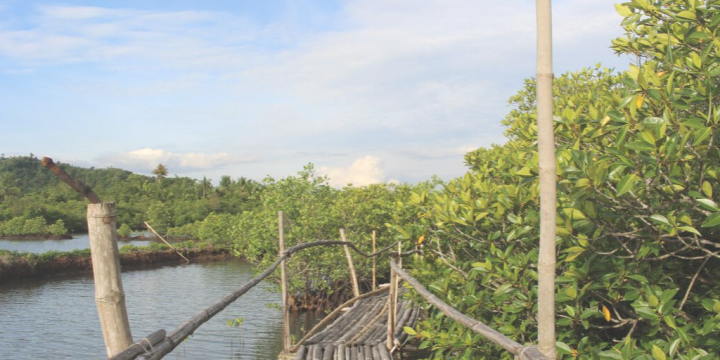
On my recent trip to the Philippines, my cousin brought us to a place called San Juan By the Bay in Santa Rita, Samar; a scenic spot that includes a boardwalk, a floating restaurant, a beautiful view of the San Juanico Bridge and mangrove restoration project (https://www.choosephilippines.com/specials/history-and-culture/4324/san-juanico-bridge-boardwalk). As we walked along the boardwalk towards the restaurant I couldn’t help but be in awe and think about how diverse and crucial this ecosystem must be for the Philippine coastlines. Looking at the twisting roots of mangrove trees along the coastline as well as the tinier mangroves that were planted to restore the forest to its former glory, I started to wonder what exactly mangroves were and the impact they have on the environment.


What are mangroves?
A mangrove is a woody tree or shrub that lives along the tropical or subtropical coastlines [1]. The term “mangrove” is also used as a term that refers to the entire community revolving the plants since their foliage and intricate root system offers a rich habitat for other plants, animals and microorganisms [1, 2]. Mangroves have evolved a distinctive dense tangle of roots above the water that allows the plants to withstand the daily rise and fall of tides [1]. These roots also enable them to slow the movement of the tidal waters and stabilize the coastline; reducing soil erosion from storm surges, currents, waves, and tides [1]. These plants have evolved to be able to live in the salty, low-oxygen soil as sediments come in and build up the muddy bottom [1,2].
What surprised me the most when researching mangroves is that according to Smithsonian Ocean [2] what is considered as a true mangrove isn’t fully known since distinguishing a mangrove species is based upon the physical and ecological traits of the plant rather than the DNA (the ancestry). Who knows, maybe what a plant that we consider a mangrove actually evolved from a totally different lineage of plants and just has similar traits to the “true mangrove”. Interestingly, there are roughly 54 “true species” of mangrove from 16 different families [2], but when you generalize and include all of the plants that live in a mangrove forest, there are well over 80 species of mangrove [1, 2].

Importance of mangroves & threats
Mangrove ecosystems are extremely productive and hold great ecological and economical importance [3,4]. Let’s look at each of these separately:
Ecologically:
- These forests provide homes for a variety of terrestrial and marine organisms (breeding grounds, food, nursing sites, etc.) [4].
- Have high rates of primary production. They accumulate carbon in tree biomass, which is then lost through decomposition and being moved to adjacent ecosystems [4].
- As mentioned before, mangroves have a dense tangle of roots [1]. These roots not only trap sediments from flowing down rivers and off the land, but they can also stabilize the coastlines by preventing erosion and any damage from waves and storms [1,4].
- It also protects coral reefs and seagrass meadows by filtering out sediments [3].
Economical:
- According to WWF, the goods and services provided by mangrove ecosystems are estimated to be worth US $186 million a year [3].
- Since mangroves are home to a large variety of marine animals, they’ve been serving as an essential area for food for thousands of coastal communities [3].
- Some plants found in this ecosystem are said to be medicinal for the coastal communities [3].
- The wood from the mangrove trees and bushes are very resistant to rot as well as insects, making them an extremely valuable and reliable for construction and fuel for many of the communities [3].
- Due to the proximity of mangrove forests to coral reefs and sandy beaches, a few countries have started to tap into the tourism potential of these environments [3].
The more we learn about mangroves and the ecosystem they provide, the more we realize how important they are to the environment and to our economy. Yet these forests are disappearing at a global loss rate of 1-2% per year, with the loss rate reaching 35% during the last 20 years [4]. WWF considers mangrove forests as one of the world’s most threatened tropical ecosystems, especially when countries such as India, the Philippines, and Vietnam have more than 50% of their mangrove forests gone [5].
The main threats to mangrove forests include [5]:
- Clearing
- Over harvesting
- River changes
- Over fishing
- Destruction of coral reefs
- Pollution
- Climate Change
Below is a recent CTV News report regarding Australia’s mangrove forests and how they’re disappearing at an alarming rate [6].
It’s crazy how despite all the benefits of mangroves and how critical they are to coastal ecosystems, nearly half of them have been cleared or destroyed [7]. Luckily, organization such as the IUCN, The Nature Conservancy and WWF have been pushing efforts for mangrove restoration. IUCN and The Nature Conservancy produced a map that demonstrates the ability of 2 billion hectares of deforested and degraded lands worldwide to restore their forests [7].
There are some companies that are helping with the restoration of mangrove forests around the world. After Typhoon Yolanda, a number of mangroves were destroyed in the Philippines. Shell (the gas company) is one of the companies that are helping the coastal communities in country as part of the Yolanda rehabilitation programme [8,9]. The Zoological Society of London (ZSL) has also partnered with Philippine communities in their restoration projects [10].
We have yet to see how well these restoration projects end up being. These projects must ensure that they are sustainable and that they are planting the correct mangrove species as well as the correct mix of species in the given area [11]. They must also ensure that the locals are adequately involved in these projects as they will most likely know more about their mangrove forest than those outside of their communities [11]. With increasing knowledge of mangroves and how to restore them, successful restoration projects are possible.
References
What mangroves are:
[1] The National Oceanic and Atmospheric Administration: What is a “mangrove” forest?
[2] ***The National Museum of Natural History: Ocean Find Your Blue: Mangroves
Mangrove importance and threats:
[3] WWF: Mangrove Importance
[4] Carugati L., et al. (2018). Impact of mangrove forests degradation on biodiversity and ecosystem functioning. Scientific Reports 8(13298). Retrieved from: https://www.nature.com/articles/s41598-018-31683-0
[5] WWF: Mangrove forests are one of the world’s most threatened tropical ecosystems
[6] CTV National News: A crucial ecosystem’s demise
Restoration efforts: the ups, downs and future prospects:
[7] IUCN: Mangrove restoration
[8] Shell Philippines: Operation Mangrove Rehabilitation
[9] Shell Philippines: Rehabilitating the Environment One Mangrove at a Time
[10] The Zoological Society of London: Rehabilitating Mangroves in the Philippines
[11] IUCN: Mass mangrove restoration: Driven by good intentions but offering limited results (2017).
More References
Primavera, J. H. and Esteban, J. M. A. (2008). A review of mangrove rehabilitation in the Philippines: successes, failures and future prospects. Wetlands Ecol Manage. DOI 10.1007/s11273-008-9101-y
American Museum of Natural History: What’s a Mangrove? And How Does it Work?
Ducan, C. at al. (2016). Rehabilitating mangrove ecosystem services: A case study on the relative benefits of abandoned pond reversion from Panay Island, Philippines. Marine Pollution Bulletin. 109(2): pp: 772-782. DOI: https://doi.org/10.1016/j.marpolbul.2016.05.049

 Noemi’s Corner